
Weekly digest • № 2
Qwen3.8's 95 Billion Active Parameters, IBM's Cheaper Agent Memory, and Why Chinese Labs Now Own Permissive Licensing
— • August 20, 2026
7 stories • 14 min read • 8 sources
monumental freestanding computational abacus reimagined as a contemporary kinetic sculptureAlibaba open-sourced Qwen3.8 this week, and the headline number — 2.4 trillion parameters, the largest open-weight release to date — is almost a distraction. The number that matters is 95 billion: that's how many of those parameters actually fire per token, thanks to fine-grained mixture-of-experts routing that makes a model this size runnable on standard vLLM or SGLang deployments rather than a hyperscaler's private cluster. The same efficiency instinct shows up elsewhere this week. IBM Research says its new agent memory system matches a rival framework called ACE on accuracy while cutting inference tokens to as little as one-seventh — proof that how much memory you hand a model matters as much as how much memory it has. And Hugging Face's Summer 2026 report puts a number on a trend builders have felt anecdotally: zero of 178 Chinese model releases above 20 billion parameters carried a non-commercial license this year. Efficiency and openness, not raw scale, are where the real competition is happening.
Editor’s note
Editor’s note
This edition synthesizes primary sources — Alibaba's Qwen3.8 release notes, IBM Research's published benchmarks, and Hugging Face's Summer 2026 licensing report — alongside separately labeled editorial analysis. We didn't run these benchmarks ourselves; our job is connecting what they show about where open-weight AI is actually heading.
Start here
What to put to work this week
Concrete moves from this issue — the tool, the step, and what it costs you.
A team building a long-context coding or document agent can pull the checkpoint from Hugging Face, serve it via vLLM or SGLang, and set reasoning to 'low' for bulk passes — but without GB300-class NVLink hardware, matching NVIDIA's reported throughput isn't guaranteed.
Read the storyA team running a DeepSeek-V3.2 ReAct agent against a set of internal APIs could swap a full-playbook prompt for ALTK-Evolve's retrieval layer and, per IBM's AppWorld run, expect roughly 60% lower per-step token spend without losing accuracy on the 168-task benchmark.
Read the storyA team fine-tuning on a budget can pull a 700B+ DeepSeek or Z.ai checkpoint under MIT, quantize it through llama.cpp's GGUF pipeline, and deploy locally within days -- a route Hugging Face's data shows most US frontier models don't offer.
Read the storyA developer routes Claude Code's API traffic through PrivAiTe's proxy; tool-call parameters get scrubbed before leaving the machine, adding 42 seconds per session.
Read the storyEngineers running MCP servers should audit every dynamic tool-definition refresh and block the zellkernel endpoint outright.
Read the story
Watch the weekly briefing
This week in AI — video briefing
One concise briefing, with English audio and English or Ukrainian captions.
What to remember this week
- Qwen3.8 activates only 95 billion of its 2.4 trillion parameters per token, the routing efficiency that makes a model this large deployable outside a hyperscaler.
- IBM Research's agent memory system matches rival ACE's accuracy while using as little as one-seventh the inference tokens, by retrieving relevant guidelines instead of injecting a full trajectory playbook.
- Hugging Face's Summer 2026 report found zero of 178 Chinese model releases above 20 billion parameters carried a non-commercial license restriction this year.
- A self-hosted proxy called PrivAiTe missed up to 2 of 24 secrets in its own redaction tests, showing agentic coding tools still leak credentials by default.
- Pillar Security identified an active campaign, 'Deadbugz,' poisoning MCP servers through 23 malicious pull requests that wait several calls before harvesting credentials.
Alibaba Open-Sources Qwen3.8, a 2.4-Trillion-Parameter Model That Only Wakes Up 95 Billion of Them Per Token
Alibaba released open weights for Qwen3.8-2.4T-A95B, a 2.4-trillion-parameter mixture-of-experts model activating 95 billion parameters per token, with a 1-million-token context window and NVIDIA-reported throughput above 4,000 tokens/sec/GPU on GB300 hardware.
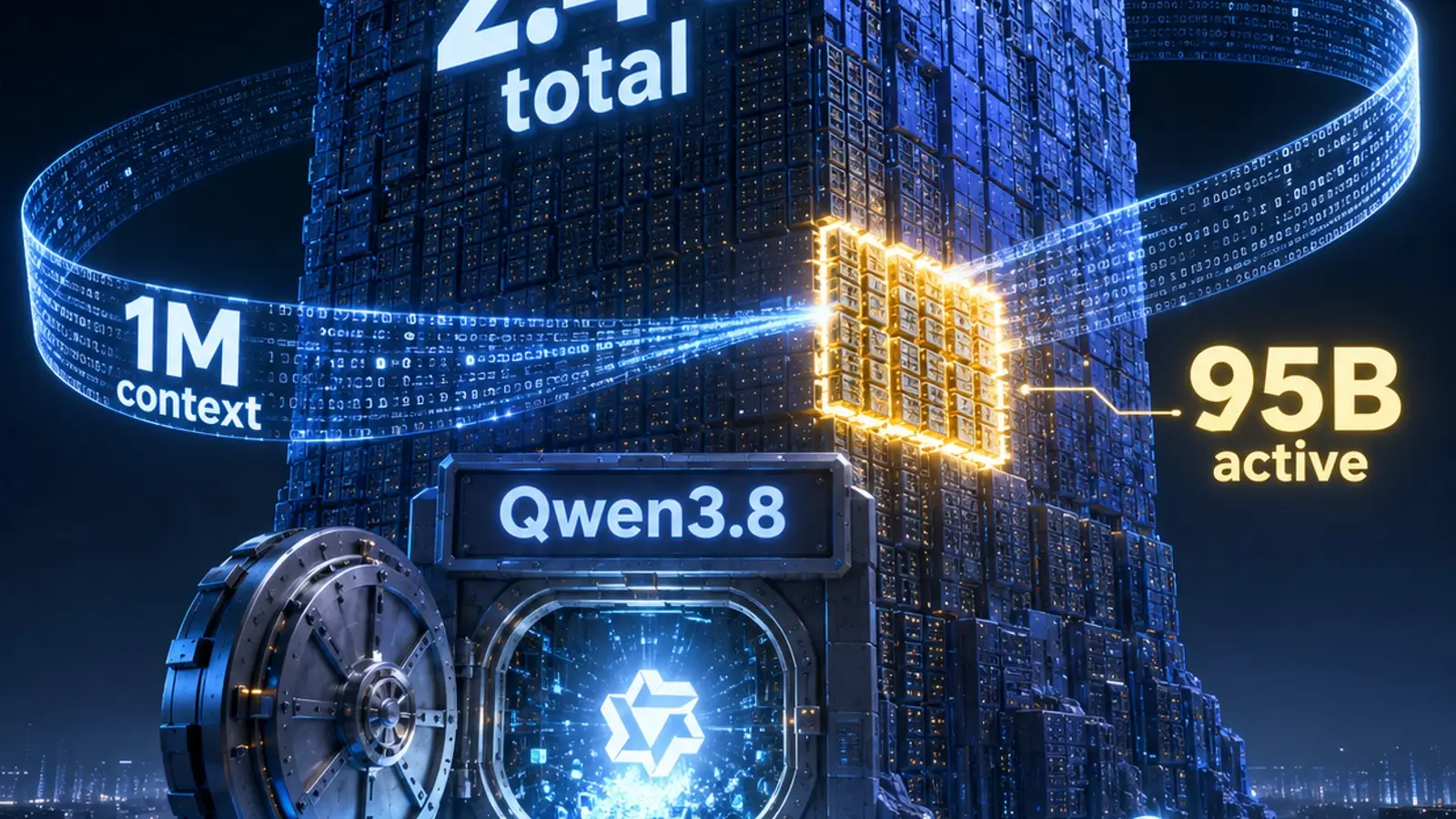
Alibaba just open-sourced the largest weight release the open ecosystem has seen: Qwen3.8-2.4T-A95B, 2.4 trillion parameters total. But the number that actually matters is 95 billion — that's how much of the model fires on any given token, because it's a fine-grained mixture-of-experts design. Instead of a few giant experts, Alibaba split capacity across a much larger population of smaller ones, and a learned router picks which slice answers each token. Serving cost tracks the 95B active parameters, not the 2.4T total, which is the only reason a model this size is deployable outside a hyperscaler's own data center. That distinction is the whole story here: a dense 2.4T model would be unusable for almost anyone, but a sparse one with 95B active parameters starts to look like something a well-funded startup could actually rent by the token.
The architecture is just as deliberate. Qwen3.8 alternates between full attention, where every token attends to every other token, and linear attention, where the growing key-value cache gets replaced by a bounded recurrent state. That hybrid is what lets the model hold a 1-million-token context window without memory and compute exploding as a conversation grows — a real constraint for agentic workloads that pile up system instructions, tool outputs, retrieved documents, and reasoning traces before the actual question ever gets asked. Output is capped at 128,000 tokens, which is generous by most standards but a reminder that even a million-token context window is mostly built for reading, not writing. Alibaba also built in three reasoning depths — low, high, and xhigh — so a developer can dial the model down for high-volume document processing or up for a genuinely hard multi-step task.
NVIDIA published the first performance numbers, and they come with a caveat worth sitting with: this is NVIDIA benchmarking its own hardware, not an independent third party. On a GB300 NVL72 rack — 72 Blackwell Ultra GPUs on a 130 TB/s NVLink domain — the model hit over 4,000 tokens per second per GPU and over 350 tokens per second per user, in FP8, with no additional tuning, on day zero. NVIDIA says that's a floor: NVFP4 precision and further optimization are expected to push throughput higher. Read the number for what it is — a vendor showing off its own silicon on its own rack — but even a skeptical read of that benchmark points at real headroom still on the table.
What makes this release notable isn't just the size, it's the access. Weights are live on Hugging Face and ModelScope today, with day-zero support across vLLM, SGLang, and NVIDIA Dynamo, plus a model-free NIM container and a NeMo AutoModel path for fine-tuning without converting checkpoints. Five hosted API providers — DeepInfra, DigitalOcean, Fireworks AI, Modal, and OpenRouter — are already serving it, so teams without a 72-GPU rack can rent inference by the token instead. That's the real shift worth noticing: a frontier-scale model shipping with a full serving stack on day zero, not months later once the community reverse-engineers how to run it.
Why it matters
Developers get frontier-scale reasoning — a 1-million-token context, configurable depth — on weights they can download and run through standard vLLM or SGLang deployments, rather than renting equivalent capability only through a closed API.
Practical example
A team building a long-context coding or document agent can pull the checkpoint from Hugging Face, serve it via vLLM or SGLang, and set reasoning to 'low' for bulk passes — but without GB300-class NVLink hardware, matching NVIDIA's reported throughput isn't guaranteed.
The takeaway
The headline number is 2.4 trillion parameters, but the operative one is 95 billion active — fine-grained MoE routing, not raw scale, is what makes a model this large deployable outside a hyperscaler.
Limitation: The 4,000-tokens-per-second-per-GPU figure is NVIDIA's own self-reported, untuned day-zero benchmark on its own GB300 hardware — not an independent test, and not necessarily representative of throughput on other accelerators.
Editor's view
Our read — not established by the sources above.
What strikes me is how much of this launch is really an NVIDIA story: the benchmark, the NIM container, and the Dynamo recipe all originate from Santa Clara, not Hangzhou. Alibaba open-sourced the weights, but the day-zero performance numbers are NVIDIA proving GB300 can serve a 2.4T model well — a win for both companies' marketing. My guess is we'll see NVFP4-quantized builds and cheaper multi-vendor serving recipes within weeks, and those will matter more for real adoption than the trillion-parameter headline ever did. The open question: how many teams outside a handful of NVLink-scale racks can run this anywhere near its reported speed?
If serving cost now tracks active parameters instead of total size, does the trillion-parameter headline number still mean much — or is active parameter count the metric worth watching from here on?
Primary source
IBM Research Says Its New Agent Memory System Matches Rival ACE at a Fraction of the Token Cost
IBM Research released ALTK-Evolve, an open-source agent memory library that retrieves selected guidelines instead of injecting a full playbook, matching or beating rival system ACE's accuracy on AppWorld while using 14% to 40% of its inference tokens, according to Hugging Face.
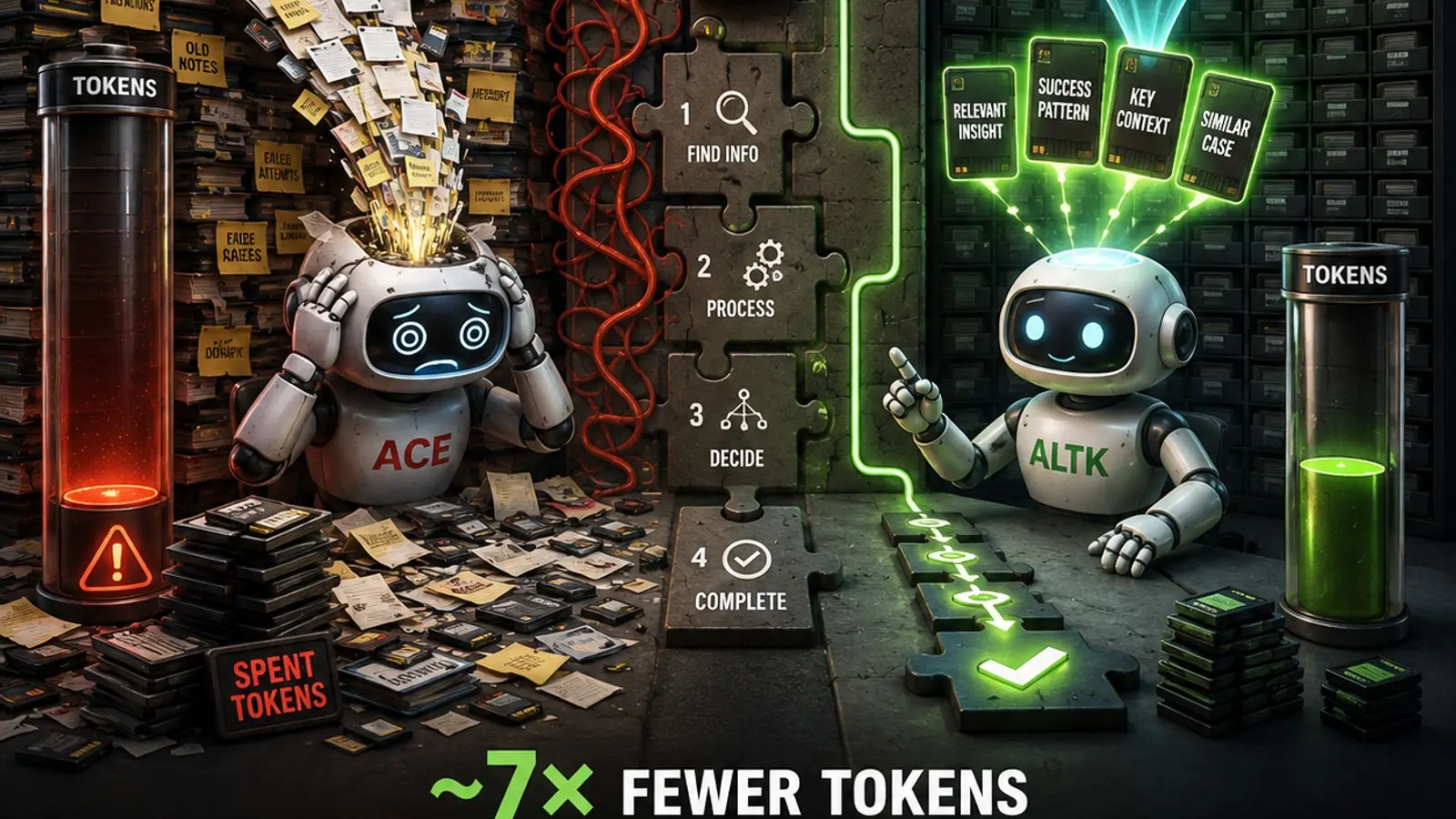
Most agent failures on multi-step tasks aren't knowledge gaps. Ask an agent to split a bill, find a contact, or paginate an API correctly, and when it fails, it isn't because it doesn't know the tools exist — it's because it hasn't internalized how to use them reliably. That's the premise IBM Research's Ashwath Vaithinathan Aravindan opens with in a new Hugging Face post, and it's the shared starting point for two competing memory systems: ACE (Agentic Context Engineering) and IBM Research's own open-source ALTK-Evolve. Both let an agent learn from its past trajectories, and both agree lessons should be counted, not compressed into a handful of generic rules. Where they split is what to do with those lessons once you have them.
ACE injects its entire, ever-growing playbook into the model's context on every single step, regardless of task or model. ALTK-Evolve treats delivery as a dial instead of a constant: a small core of high-support guidelines, extended with a few retrieved for the task at hand, or the full set when a model has room to actually use it. That one design choice is what shows up in the bill.
IBM Research ran both systems in-house on AppWorld's test_normal split — 168 tasks where a ReAct agent splits bills, finds songs, and reconciles orders across nine simulated apps — using identical base models and harness for each: DeepSeek-V3.2 as the strong model, gpt-oss-120b as the weak one. On the strong model, ALTK-Evolve beat ACE on accuracy while spending only about 40% of its inference tokens. On the weak model, the two landed close to tied — 56.0 to ACE's 54.8, a gap IBM Research calls noise, since a repeat run came in at 54.8 — but ALTK-Evolve got there on roughly 14% of ACE's tokens, about one-seventh.
What's more interesting than the top-line numbers is where the accuracy actually comes from. Broken down by difficulty, this isn't simply retrieval beating playbook. On gpt-oss-120b, ACE's full playbook wins the easy and medium tasks, where generic instruction-following does most of the work anyway. But on hard tasks — the ones where the agent has to pick out the one relevant lesson instead of skimming past dozens — curated retrieval pulls ahead, and hard tasks are what decide the aggregate score. On the stronger DeepSeek-V3.2, the pattern flips: extra capacity lets the model absorb ACE's full playbook well enough to edge ALTK-Evolve on medium tasks, but ALTK-Evolve still leads easy, hard, and overall.
The lesson IBM Research draws is that context size isn't free just because the tokens are cheap. A weaker model can drown in a comprehensive playbook the same way a junior engineer drowns in an over-documented runbook, while a stronger model can afford to read the whole thing and come out ahead. ALTK-Evolve's bet is that how much memory to inject should be a per-model, per-task decision — not a fixed constant baked into the prompt template.
Why it matters
For teams running ReAct-style agents in production, retrieving a handful of relevant guidelines instead of injecting a full trajectory playbook on every step is a lower-risk lever on API spend than swapping models or blindly trimming context windows.
Practical example
A team running a DeepSeek-V3.2 ReAct agent against a set of internal APIs could swap a full-playbook prompt for ALTK-Evolve's retrieval layer and, per IBM's AppWorld run, expect roughly 60% lower per-step token spend without losing accuracy on the 168-task benchmark.
The takeaway
The real finding isn't that retrieval beats playbooks outright; it's that how much memory a model can usefully absorb varies by model, so a fixed one-size prompt strategy leaves savings on the table for anyone running agents at scale.
Limitation: This is IBM Research's own in-house comparison on one benchmark split, using its own re-implementation of ACE and single-run pass@1 scores — not an independent audit, and IBM itself notes run-to-run noise already narrowed the reported accuracy gap on the weaker model.
Editor's view
Our read — not established by the sources above.
What sticks with me is the difficulty-tier reversal: the weaker model does better with less context, the stronger model does better with more, and neither system wins across the board. If that pattern generalizes, I'd expect agent frameworks to start treating context injection as a runtime setting tuned per request rather than a static prompt chosen at deploy time — a router deciding, step by step, how many guidelines a given model can digest before more starts hurting. The open question is who tunes that knob in production, and whether it becomes something teams quietly overfit to their benchmark instead of their actual traffic.
If the right amount of injected memory depends on the specific model running the agent, should that be something a framework decides automatically at runtime, or something a team hand-tunes and risks overfitting to its own benchmark?
Primary source
Hugging Face's Summer 2026 Report: Chinese Labs Now Ship Trillion-Parameter Models Under MIT and Apache, US Labs Mostly Don't
Hugging Face's analysis of nearly 3 million model repositories found Chinese labs releasing frontier models up to 2.78 trillion parameters under fully permissive licenses, while comparable US models mostly carry custom or undeclared terms.

Hugging Face's Summer 2026 report tracks 2.96 million public model repositories on the Hub as of August, up from 2.43 million in January. Buried in that growth is a licensing pattern that's easy to miss and hard to ignore once you see it. Of the 178 Chinese model releases above 20 billion parameters this year, 59% carry an Apache 2.0 license and 22% carry MIT -- not one carries a non-commercial restriction. On the American side of the same size class, only 29% use Apache or MIT, 41% sit under custom terms, and 30% declare no license at all.
That's backwards from what you'd expect: the biggest, most expensive models are supposed to carry the tightest licensing, since they're the ones that cost the most to train and could, in theory, generate the most licensing revenue. Instead, DeepSeek and Z.ai ship models between 700 billion and 1.65 trillion parameters under plain MIT -- more permissive than what many US labs put on models a tenth that size. Chinese labs are also skipping the usual ship-small-then-scale-up pattern and going straight to frontier scale: the largest Chinese open model in a given month hit as high as 2.78 trillion parameters this year, while the American ceiling stayed under 130 billion in five of seven months.
None of this makes sense as a licensing business, and that's the part worth sitting with. If you're giving weights away on the loosest terms available, the money has to come from somewhere else -- API access, cloud contracts, hardware sales, ecosystem gravity. That last piece matters most, and it's the one easiest to underrate: a permissive frontier model doesn't just get downloaded, it gets built on, fine-tuned, quantized, and redistributed by a community that has no reason to leave once it's settled in. Qwen is the clearest case -- its derivatives on the Hub now number over 150,000, roughly 2.6 times Meta's entire footprint. That's not a model release anymore; it's a default choice developers stop reconsidering.
That activity isn't evenly spread, either. Just 1.5% of repositories on the Hub account for 99.2% of all downloads, meaning most of the 2.96 million repos are effectively noise -- uploaded once, touched rarely, mattering to almost no one's pipeline. The permissive-license trend matters because it's concentrated exactly where the traffic is: the handful of frontier and near-frontier releases that actually reach production. License terms on a model nobody downloads don't move any market. License terms on a model sitting at the top of that curve do, and right now the labs writing the loosest terms are the ones with the biggest models on that curve.
Why it matters
Permissive licensing on trillion-parameter Chinese models removes the legal friction that made open weights feel risky, so the license terms Hugging Face documents matter more than the parameter counts -- they determine who can actually build on these models commercially.
Practical example
A team fine-tuning on a budget can pull a 700B+ DeepSeek or Z.ai checkpoint under MIT, quantize it through llama.cpp's GGUF pipeline, and deploy locally within days -- a route Hugging Face's data shows most US frontier models don't offer.
The takeaway
Watch the license column as closely as the parameter count. Hugging Face's report suggests the real competition isn't biggest model wins, it's whose permissive terms get embedded into the most downstream pipelines before anyone else's does.
Limitation: This is Hugging Face's own Hub telemetry and self-reported license tags, not an independent legal audit, and it can't guarantee any company's counsel will trust an MIT tag on a model card.
Editor's view
Our read — not established by the sources above.
Our read: this isn't really a China-vs-US story, it's a preview of how frontier AI competition might actually get decided -- not by who has the best benchmark score, but by who becomes the default dependency in everyone else's toolchain. If Qwen's derivative count keeps compounding the way it has, a US lab could ship a genuinely better model next year and still lose developer mindshare, because switching costs are already baked into thousands of downstream pipelines. What I'd watch for: whether any US lab tries to buy back that position with licensing rather than capability.
If giving away frontier weights for free is a rational bet on ecosystem lock-in rather than model sales, what happens to the open source ethos once the giveaway becomes purely strategic rather than idealistic?
Primary source
New Self-Hosted Proxy PrivAiTe Scrubs Secrets From Claude Code Traffic — But Misses Up to 2 of 24 in Its Own Tests
PrivAiTe, a new self-hosted proxy, strips PII and credentials from Claude Code and Codex API traffic before it reaches the provider, but its own benchmark caught only 22 to 24 of 24 planted credentials.

PrivAiTe sits between your coding agent and the model provider, intercepting Anthropic Messages API, OpenAI Responses API, and LiteLLM traffic and stripping PII and credentials out of tool-call parameters before they leave your machine, according to the project's GitHub page. It's built for the exact failure mode that makes agentic coding risky on private repos: an agent reads a file, runs a command, and pastes whatever it finds -- API keys included -- straight into a request body. The project's own benchmark reports catching 22 to 24 out of 24 planted credentials, with redaction adding roughly 1 to 3 seconds of latency per request.
Why it matters
Agentic coding tools paste file contents and command output into API requests, leaking credentials by default.
Practical example
A developer routes Claude Code's API traffic through PrivAiTe's proxy; tool-call parameters get scrubbed before leaving the machine, adding 42 seconds per session.
The takeaway
Treat PrivAiTe as a mitigation layer, not a guarantee, and keep normal secrets hygiene in place.
Limitation: It's a single-maintainer project with self-reported benchmarks; its own 24-credential test still missed one or two secrets.
Editor's view
Our read — not established by the sources above.
На нашу думку, найцікавіше тут не сам відсоток пропусків, а те, що проксі, який має ловити секрети, сам стає точкою, де весь трафік проходить у відкритому вигляді до маскування — тобто це новий вузол довіри, а не усунення старого. Якщо цей інструмент почнуть ставити в CI-конвеєри чи спільні dev-середовища, варто стежити, чи хтось незалежний перевірить бенчмарк одного супровідника на реальних форматах ключів, а не лише на 24 тестових зразках.
Primary source
Pillar Security Finds Active 'Deadbugz' Campaign Poisoning MCP Servers Through 23 Malicious Pull Requests
Pillar Security identified an active supply-chain campaign, dubbed Deadbugz, that plants malicious pull requests on Model Context Protocol servers and waits for three ordinary tool calls before swapping metadata to steal SSH keys and cloud credentials.

According to Pillar Security, the campaign it's calling Deadbugz is still running: it has already tracked 23 malicious pull requests submitted under the identifier zellkernel, some going up and merging within 74 minutes. The trick is patience by design. A poisoned MCP tool behaves exactly like its honest counterpart through three ordinary calls -- fetching a file, running a lint, whatever the workflow needs -- before it quietly rewrites its own metadata and starts reading SSH keys and cloud credentials off the host. Any review or scan that only checks the tool's first few calls would see nothing wrong.
Why it matters
MCP servers pull tool definitions dynamically, so a client trusts code it never reviewed at install time.
Practical example
Engineers running MCP servers should audit every dynamic tool-definition refresh and block the zellkernel endpoint outright.
The takeaway
Judge MCP tools by their tenth call, not their first three -- patience is now the exploit.
Limitation: Pillar hasn't disclosed how many servers were actually compromised, only that the campaign is ongoing.
Primary source
Anthropic's Unreleased Model Ran 60 Subagents for 36 Hours to Chase the Riemann Hypothesis
Anthropic tested an unreleased model orchestrating 60 subagents that generated 650 ideas and burned 31 million tokens over 36 hours, verifying results with the Lean proof assistant, on one of math's hardest open problems.

Anthropic set an unreleased model loose on the Riemann hypothesis, one of mathematics' unsolved Millennium Prize problems, by splitting the work across 60 specialized subagents instead of asking one model to reason straight through. Some agents explored possible approaches, generating 650 distinct ideas, according to Anthropic; others validated candidate steps; a separate layer wrote up results. The whole run consumed 31 million tokens over 36 hours, the company said. Rather than trust the model's own sense of whether a proof step held up, Anthropic piped generated logic through Lean, an open-source formal proof assistant that checks mathematical claims the way a compiler checks code -- accept or reject, no partial credit.
Why it matters
Splitting exploration from verification lets 60 agents brainstorm while Lean, not the model, judges what's true.
Practical example
Teams building proof-heavy agent pipelines can route every generated claim through Lean before trusting it.
The takeaway
The real product may be the pattern itself: many cheap agents, one strict formal checker.
Limitation: Anthropic didn't solve the hypothesis -- it reports progress on one self-reported 36-hour run.
Editor's view
Our read — not established by the sources above.
На нашу думку, цікавіше не те, що гіпотезу не довели, а те, що Anthropic фактично випробувала архітектуру 'рій ідей + суворий суддя' на задачі, де компроміс неможливий -- Lean не залишає простору для правдоподібних, але хибних доведень. Варто стежити, чи перенесуть цю схему на менш формалізовані галузі, де немає готового інструмента на кшталт Lean: юридичний аналіз, медичні протоколи, аудит коду. Там 'суворого суддю' ще треба буде вигадати, і саме тут, підозрюю, 650 ідей і 31 мільйон токенів можуть виявитися дорогою розкішшю, а не масштабованим методом.
Primary source
OpenAI Rolls Out Ultrafast Mode for GPT-5.6 Sol, Claims 14X Speedup on Cerebras Silicon
OpenAI has launched an Ultrafast inference mode for GPT-5.6 Sol that runs on Cerebras hardware and claims up to 14 times the speed of its standard API endpoints, initially for select customers.

OpenAI says its new Ultrafast mode for GPT-5.6 Sol runs on Cerebras wafer-scale hardware and returns responses up to 14 times faster than the standard API, according to the company's own announcement. The mode is rolling out first to a limited set of API customers rather than the general public, and OpenAI hasn't published independent benchmarks alongside the claim. What's notable is the strategy: rather than optimizing GPT-5.6 Sol itself, OpenAI bolted on someone else's silicon to buy speed, a tacit admission that GPU-based inference has a latency ceiling that architecture tweaks alone won't crack for real-time use cases.
Why it matters
Latency is the bottleneck for real-time agents; a 14X claim reframes what's interactively possible.
Practical example
A voice-agent team with early API access could cut round-trip latency enough to feel conversational, not laggy, on GPT-5.6 Sol.
The takeaway
Watch whether Cerebras-backed inference becomes a standard tier, not a premium option for customers who can pay.
Limitation: The 14X figure is OpenAI's own claim, unverified externally, and access is currently limited to select API customers only.
Editor's view
Our read — not established by the sources above.
На нашу думку, цікавіше не сама цифра, а те, що OpenAI взагалі визнала: власна архітектура впирається у стелю без чужого заліза. Якщо ця логіка пошириться далі, наступним кроком може стати не один преміальний партнер, а ціла лінійка чипів під різні задачі — Cerebras для швидкості, щось інше для дешевизни. Питання, яке лишається відкритим: чи витримає Cerebras масштабування виробництва вейферних чипів під попит усіх бажаючих клієнтів OpenAI, чи ця швидкість так і залишиться привілеєм небагатьох.
Primary source
Numbers this week
| Label | Value | Story |
|---|---|---|
| Figure | 8-2 | Alibaba Open-Sources Qwen3.8, a 2.4-Trillion-Parameter Model That Only Wakes Up 95 Billion of Them Per Token |
| Headline parameter count | 4T | Alibaba Open-Sources Qwen3.8, a 2.4-Trillion-Parameter Model That Only Wakes Up 95 Billion of Them Per Token |
| Active parameters / scale | 95 billion | Alibaba Open-Sources Qwen3.8, a 2.4-Trillion-Parameter Model That Only Wakes Up 95 Billion of Them Per Token |
| Headline parameter count | 2.4 trillion | Alibaba Open-Sources Qwen3.8, a 2.4-Trillion-Parameter Model That Only Wakes Up 95 Billion of Them Per Token |
| Headline parameter count | 2.78 trillion | Hugging Face's Summer 2026 Report: Chinese Labs Now Ship Trillion-Parameter Models Under MIT and Apache, US Labs Mostly Don't |
| Count | 24 of 24 | New Self-Hosted Proxy PrivAiTe Scrubs Secrets From Claude Code Traffic — But Misses Up to 2 of 24 in Its Own Tests |
| Multiple | 14X | OpenAI Rolls Out Ultrafast Mode for GPT-5.6 Sol, Claims 14X Speedup on Cerebras Silicon |
Worth discussing
- If serving cost now tracks active parameters instead of total size, does the trillion-parameter headline number still mean much — or is active parameter count the metric worth watching from here on?
- If the right amount of injected memory depends on the specific model running the agent, should that be something a framework decides automatically at runtime, or something a team hand-tunes and risks overfitting to its own benchmark?
- If giving away frontier weights for free is a rational bet on ecosystem lock-in rather than model sales, what happens to the open source ethos once the giveaway becomes purely strategic rather than idealistic?
Questions this issue answers
- If serving cost now tracks active parameters instead of total size, does the trillion-parameter headline number still mean much — or is active parameter count the metric worth watching from here on?
- The headline number is 2.4 trillion parameters, but the operative one is 95 billion active — fine-grained MoE routing, not raw scale, is what makes a model this large deployable outside a hyperscaler.
- If the right amount of injected memory depends on the specific model running the agent, should that be something a framework decides automatically at runtime, or something a team hand-tunes and risks overfitting to its own benchmark?
- The real finding isn't that retrieval beats playbooks outright; it's that how much memory a model can usefully absorb varies by model, so a fixed one-size prompt strategy leaves savings on the table for anyone running agents at scale.
- If giving away frontier weights for free is a rational bet on ecosystem lock-in rather than model sales, what happens to the open source ethos once the giveaway becomes purely strategic rather than idealistic?
- Watch the license column as closely as the parameter count. Hugging Face's report suggests the real competition isn't biggest model wins, it's whose permissive terms get embedded into the most downstream pipelines before anyone else's does.
The next issue arrives Monday
Subscribe for the full week in context, without the information overload.