Oleksandr Kuzmenko, EditorPublished 6 min readAI-assisted · editor-reviewed
TL;DR
- Claude Code successfully patched embedded C++ ESP32 firmware using conversational prompts without manual driver edits.
- Simple natural language directives implemented audio duration gating and third-party ElevenLabs TTS integration.
- Bluetooth phone controls, camera shutter actions, and stateful mini-games can be vibe-coded directly onto cheap microcontrollers.
Key facts
- Hardware unit cost
- $50 (Waveshare ESP32-S3 1.75C)
- Display specification
- 1.75-inch circular touchscreen
- Firmware tooling
- Claude Code CLI agent
- Third-party audio backend
- ElevenLabs free tier TTS
Transforming Stock Devkits with Claude Code
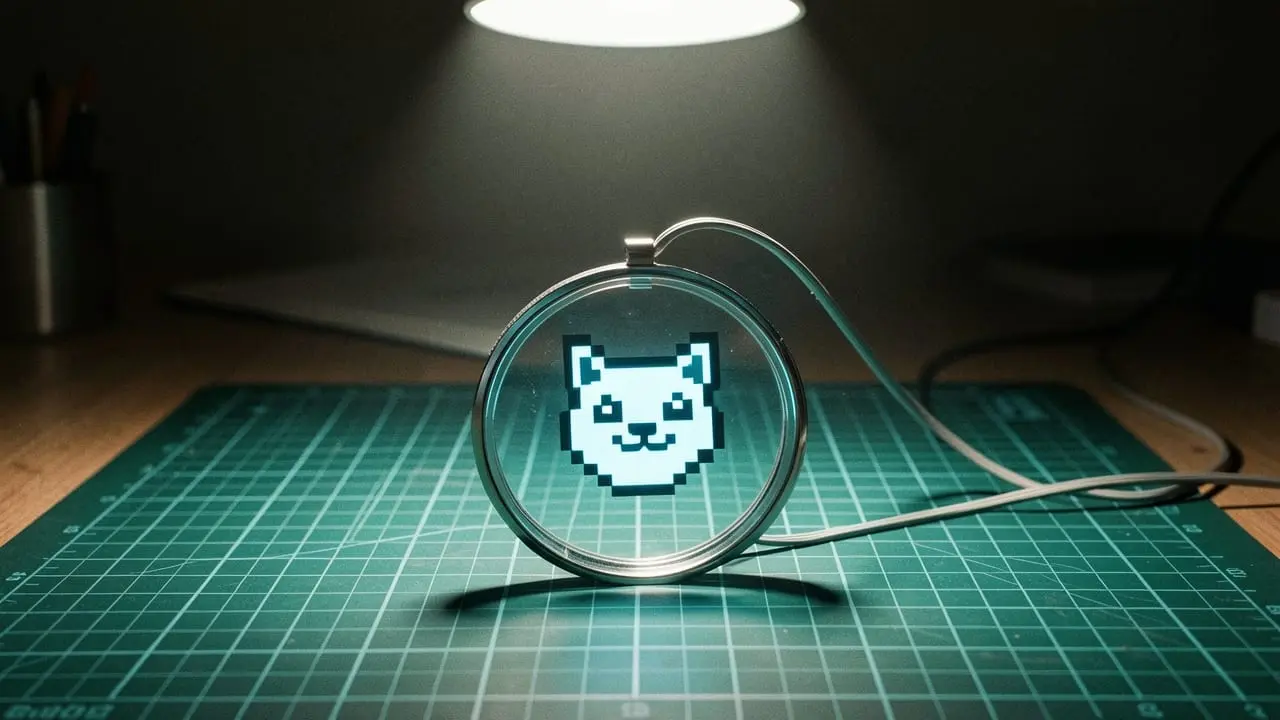
Meta recently published open-source firmware and connection tokens enabling developers to link microcontrollers directly to its Muse AI cloud. The reference hardware—the $50 Waveshare ESP32-S3 1.75C circular touchscreen pendant—ships with minimal software: push-to-talk transcription, a single static avatar, and no local audio playback.
By pointing Claude Code directly at Meta's GitHub repository, the entire firmware was rewritten in several conversational iterations without manually modifying C++ header files or display drivers:
- Audio Handling: Injected a minimum duration gate dropping voice packets under 1 second to eliminate backend parser crashes from premature button release.
- Audio Output: Connected an ElevenLabs API integration, routing spoken British synthetic voice responses back through device audio buffers.
- UI and History: Added horizontal swipe gestures to review previous conversation turns, overcoming the physical limitations of the 1.75-inch circular screen.
Bluetooth Camera Controls and Interactive State Machines
Beyond basic chat capabilities, Claude Code implemented hardware peripheral integrations on the ESP32-S3:
1. Remote Shutter and Preview: Configured a button to trigger smartphone photo capture remotely alongside a low-quality camera preview over Bluetooth, correcting front-facing camera orientation. 2. Stateful Game Engine: Programmed an interactive pet minigame tracking hunger, boredom, and cleanliness across four distinct metric levels. 3. Analog Watchface: Generated an animated 3-hand analog clock rendered dynamically on the circular display within 15 minutes.
When to use
- Use when rapidly iterating on prototype interfaces and hobbyist IoT features for low-cost microcontrollers.
When NOT to use
- Do not deploy unverified agent-generated embedded code into safety-critical or mission-critical hardware environments.
What to do today
- Evaluate coding agent CLIs like Claude Code for fast prototyping on ESP32 hardware devkits.
- Add input-length guards when sending microphone streams to speech recognition backends to prevent empty-buffer crashes.
Step names are taken from What to do today.
Step names are taken from What to do today. Evaluate coding agent CLIs like Claude Code for fast prototyping on ESP32 hardware devkits.. Add input-length guards when sending microphone streams to speech recognition backends to prevent empty-buffer crashes.
- Evaluate coding agent CLIs like Claude Code for fast prototyping on ESP32 hardware devkits.
- Add input-length guards when sending microphone streams to speech recognition backends to prevent empty-buffer crashes.