Oleksandr Kuzmenko, EditorPublished 6 min readAI-assisted · editor-reviewed
TL;DR
- General frontier vision models can replace custom domain classifiers when guided by structured visual heuristics.
- Raw sensor point-cloud cross-checking provides a deterministic verification layer against vision agent hallucinations.
- Parallelizing across 48 agent threads collapses multi-month visual manual review tasks into overnight runs.
Key facts
- Surveyed Area
- 1,200 km²
- Agent Fleet Size
- 48 parallel agents
- Pyramid Height
- 8–12 m
- Canopy Depth
- 10–17 m
- Turnaround Time
- < 72 hours
Source: Key facts — Surveyed Area, Pyramid Height, Canopy Depth
Source: Key facts. Surveyed Area: 1,200 km². Pyramid Height: 8–12 m. Canopy Depth: 10–17 m. Each figure is copied from the story.
- Surveyed Area1,200 km²
- Pyramid Height8–12 m
- Canopy Depth10–17 m
Multi-Agent Visual Scanning Over Lidar Strips
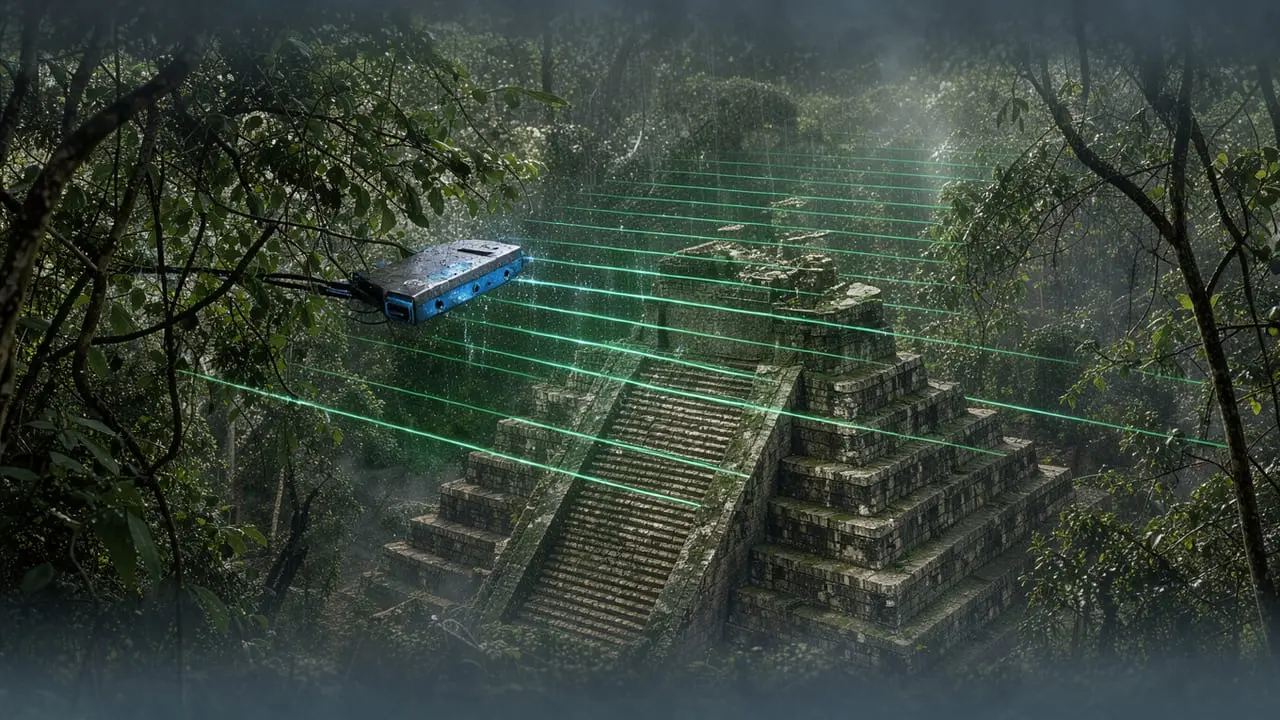
Instead of building custom machine learning classifiers, the workflow converted approximately 1,200 km² of public NASA G-LiHT lidar canopy data into high-contrast 2D elevation images. A distributed team of 48 agents (combining Gemini, Claude, ChatGPT, and Grok) iterated over the image tiles in parallel. Guided by visual heuristics, the agents searched for right angles, levelled plazas, and stepped platforms that do not occur naturally in dense jungle terrain.
Ground-Truth Verification in 3D Point Clouds
To rule out canopy artifacts, the pipeline inspected raw lidar point clouds across vertical cross-sections. While trees accounted for 10–17 m of dense vegetation (represented by green points), the filtered ground points (brown) revealed sharp, leveled artificial topography. The discovered civic center includes an oval pyramid standing 8–12 m tall, a raised courtyard, and a potential water reservoir (aguada), typical of Classic period Maya settlements (AD 250–900).
Autonomous Reporting and Institutional Hand-Off
Once cross-checking against published literature and archives revealed no prior registration, the agents drafted a technical report and translated it into formal Spanish. Mexico’s National Institute of Anthropology and History (INAH) responded officially within 72 hours, confirming that no archaeological site had ever been registered at the provided coordinates.
Try it in 2 minutes
import concurrent.futures

def inspect_lidar_tile(tile_id, image_bytes):
    return agent_client.analyze(
        image=image_bytes,
        prompt="Identify non-natural rectilinear formations, pyramids, or plazas. Flag coordinates."
    )

with concurrent.futures.ThreadPoolExecutor(max_workers=48) as executor:
    results = list(executor.map(lambda t: inspect_lidar_tile(*t), tile_manifest))
When to use
- Scanning massive unlabelled visual datasets where training custom detection models is cost-prohibitive.
- Decomposing open-ended discovery tasks into parallel tile-by-tile heuristic evaluations.
What to do today
- Slice high-resolution spatial datasets into discrete image tiles before feeding them into multimodal agent pipelines.
- Implement an orthogonal verification layer (such as raw point clouds or tabular metrics) to validate agent findings.
- Automate report drafting and localization with agent chains to expedite external review processes.
Step names are taken from What to do today.
Step names are taken from What to do today. Slice high-resolution spatial datasets into discrete image tiles before feeding them into multimodal agent pipelines.. Implement an orthogonal verification layer (such as raw point clouds or tabular metrics) to validate agent findings.. Automate report drafting and localization with agent chains to expedite external review processes.
- Slice high-resolution spatial datasets into discrete image tiles before feeding them into multimodal agent pipelines.
- Implement an orthogonal verification layer (such as raw point clouds or tabular metrics) to validate agent findings.
- Automate report drafting and localization with agent chains to expedite external review processes.
What the community says
The approach did work, but the discovery isn't new. Independent re-discovery happens all the time science.
agents reliably and repeatedly make claims of novelty that are based on having read ~80% of existing research. Obviously to make an actual well-grounded claim of novelty you basically need to approach 100%.